
Women’s History month, now celebrated in March, has recent and diminutive origins. With large ambitions to celebrate women’s contributions to this nation’s history from its inception, the designation began simply with one California school district’s initiative. In 1978, Sonoma County schoolchildren participated in a weeklong celebration of women’s contributions to culture, history and society. Hundreds of students entered an essay contest with “Real Women” as its topic. As interest spread to other school districts, President Jimmy Carter took note and in 1980 proclaimed the week of March 8 as National Women’s History Week. In 1987, Congress passed a law extending the designation to the full month. Subsequent presidents continue to issue an annual proclamation.
Source: history.com/articles/womens-history-month
Andrew Reid’s article, “Socialite Turned Suffragist: The Life and Times of Anna Constable” published in the annual Lewis County Historical Society Journal (v.41, 2020), reveals one prominent women’s gradual acclimation to a position that seemed both radical and long overdue. It is an engaging portrayal of an individual coming to terms with a new reality, and offers a light touch on a weighty subject.
The Constable family is one of the oldest in Lewis County. Dr. John Constable first came to the Americas from Ireland with his family as a surgeon in the British Army during the French and Indian Wars. His son, William Kerin, established a business in the fur trade between New York and Detroit. When the American War for Independence broke out, he spent time in Philadelphia, eventually siding with the Patriot cause and serving on the staff of the General Marquis de Lafayette. After the war he relocated to New York City, expanded his merchant business, and eventually entered into land speculation. Most notably he negotiated the acquisition of Macomb’s Purchase, a tenth of modern New York State (3,607,175 acres),
including Lewis County. When his partners withdrew, Constable became the main proprietor and developer, but died before he was able to visit his North Country lands.
William Constable, Jr. inherited and then settled in the North Country with his new bride Mary McVickar, and built the lovely Constable Hall in 1819. Unfortunately, he died only two years after the mansion was finished. This left his widow to raise their five children. Mary was related to several prominent New York City families but also maintained family and social connections in Philadelphia. James, the third son, relocated to Philadelphia, marrying Sarah Lippincott Richards, the offspring of two prominent Philadelphia merchant families. James and Sarah had five children: two sons, Stevenson and Howard, and three daughters, the youngest named Anna.
Shortly after Anna was added to the family on 17 May 1867, a witty birth announcement letter written by her mother was sent to her grandmother at Constable Hall. Anna grew up in a post-war era where a great deal of attention was given to issues of voting, representation, and equality. The conflict had interrupted a women’s rights movement that had been gaining momentum prior to the outbreak of war, most notably at the 1849 Seneca Falls Convention. Many suffragists had also been heavily involved in the abolition movement, and the irony was not lost on them after the war that they who had helped fight to make African Americans free remained disenfranchised while the freedmen gained the vote.
Anna spent her childhood at 1820 Delaney Place in a prestigious neighborhood in Philadelphia, but she travelled often. This included summer trips to her father’s birthplace in Lewis County. In the 1880s, Anna’s older sisters both died from tuberculosis. The following decade, Anna’s father and mother also passed away, the latter while she was travelling through Europe with Anna in 1894.
Left to make her own decisions, Anna joined her brothers in New York City. They promptly entered the Manhattan social scene. The annual Constable soirée, specifically themed around “Mi-Carême,” became the talk of the town. These events, largely planned by Anna, demonstrate her awareness of world affairs and political sentiments. In 1903, the siblings went their separate ways, and Anna shifted to helping host benefit events, which brought her into more mature circles interested in politics.
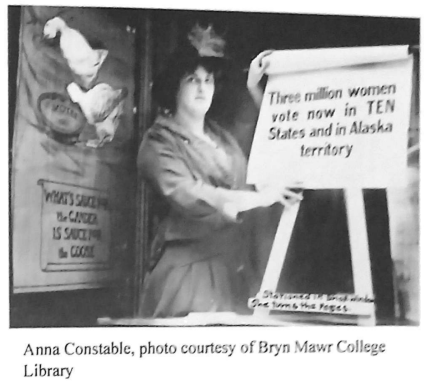
Anna’s transition to a suffragist was gradual, but a 1912 incident thrust her into prominence. While performing “voiceless speeches” in a shop window to advertise a “Suffrage Ball,” she was given a summons by police for “blocking traffic”. This unfair treatment drew Anna into an even more active role in the movement. She rose through the executive ranks and was chosen in 1913 as a delegate for the Woman’s Political Union (WPU).
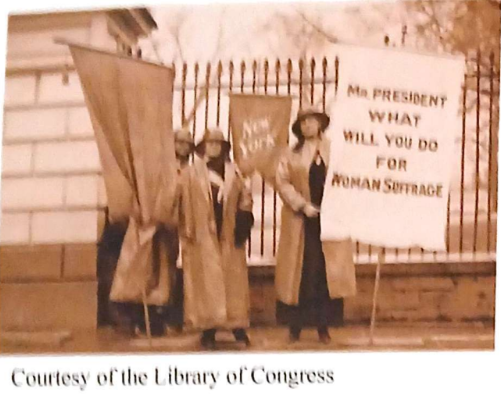
She eventually met with President Wilson and joined the “Suffrage Special” train tour to the West, which led to the formation of the National Woman’s Party (NWP). Anna was also one of the “Silent Sentinels” who picketed the White House. Even after the U.S. entered World War I, Anna and the NWP continued to picket and protest. Following years of pressure and the imprisonment of many activists, Wilson eventually supported equal suffrage, which was achieved with the 19th Amendment in 1920.
Anna remained active in the NWP and organized benefits until she passed away from heart disease on February 24, 1922. Her obituary described her as a “pioneer worker for woman’s suffrage” who traveled from coast to coast for the movement.