
Enjoy Charlotte Beagle’s journal article (below) about Lowville Academy and Central School’s first band director. Recalling the significant contributions of Luther B. Askin, Jr., founder of and longtime teacher of the school’s instrumental music program, brings home our celebration of February as Black History Month.
Beginning in 1926 with a week-long recognition of Black history, Dr. Carter G. Woodson spearheaded the efforts to popularize this knowledge. Honoring tradition, he chose the month of February in order to commemorate the births of Abraham Lincoln, February 12, and Frederick Douglass, prominent abolitionist and author, ca. February 14. Since Lincoln’s assassination in 1865, the Black community had been celebrating the President’s birthday, and since the late 1890s, communities across the country had been celebrating Douglass’. However, rather than focusing on these two men, Woodson advocated for the countless black men and women who had contributed to the advance of human civilization.
In the 1940s, efforts expanded to include topics in the school curriculum and in public celebrations. The Civil Rights movement’s Freedom Schools provided additional intellectual energy to advance social change. By the 1960s, Negro History Week was on its way to becoming Black History Month. Eventually, more than 400 years of Black history and heritage were preserved in national parks and communities around the country. Source: https://asalh.org/about-us/origins-of-black-history-month/
However homogeneous the population of Lewis County appears, we have all, children and adults, benefitted from the diversity that comprises the United States, and Mr. Askin’s talent and dedication to cultural enrichment is a local reminder of that. Each year’s final musical performance at Lowville Academy ends with the most prestigious recognition, the Luther B. Askin Award, given to a graduating senior chosen by their peers in the high school band ensemble. Mr. Askin was Lowville’s first band director from 1930 to 1960 and was responsible for setting high standards in musical performance (and for getting uniforms for the band). This award goes to a senior instrumentalist who has contributed effort, enthusiasm, and talent to the musical organization. Begun in 1962, its first winner was Thomas O’Hare, as current band director, Kelly Kilcer, relates. At the band concert, the school Superintendent Becky Dunckel reads the name of every winner since 1962 and asks them to stand if they are in attendance.
“Some people come into our lives, leave footprints on our hearts, and we ate never the same,” said Franz Shubert (31 January 1797 — 19 November 1828).
Such a person was Luther B. Askin (1887-1965) also called “the Sousa of the North Country” and the first African American teacher at Lowville Academy. According to Gordon Allen, retired editor of the Journal & Republican, Luther B. Askin started his professional career at age 14 at a roller skating rink in Holyoke, MA. His second position was in the Gentry Show in Indiana and later the Metropolitan Amusement Band in Peoria, IL. He returned to New England and eventually joined the Archie White Minstrel which had a one nightstand in Lowville.
Luther B. Askin’s 1908 arrival soon transformed music education in both Lewis County and the North Country. After his concert solo with this circus band resulted in a contract to direct the village band, the A. White Minstrels left town without him.
In 1920 Askin started lessons in Huntsville, Canada with Herbert L. Clarke (1867-1942) who was the best-known cornet soloist in America during the first two decades of the twentieth century. Clarke served as cornet soloist for John Philip Sousa’s Band and conducted that ensemble on many Victor records. He commented to Askin that although he came from New York State he played the cornet like musicians from
the New England states. Askin replied that he started cornet lessons at fourteen in Holyoke. Then he studied with Ned Lafricain of Boston, who played first trumpet in the Boston Opera. By 1927 he studied violin with Albert Kuenzler of the Utica Conservatory of Music. He was awarded a Bachelor of Science in 1938 after summer courses at Cornell University.
Lowville Academy Principal Leon Davis hired Askin as a part-time faculty member in 1927. The first school band formed a year later with fifteen members. Today the school’s music program has seven ensembles: beginner band, elementary band, middle school band, two jazz ensembles and a marching band. Approximately 200 students participate in these music bands.
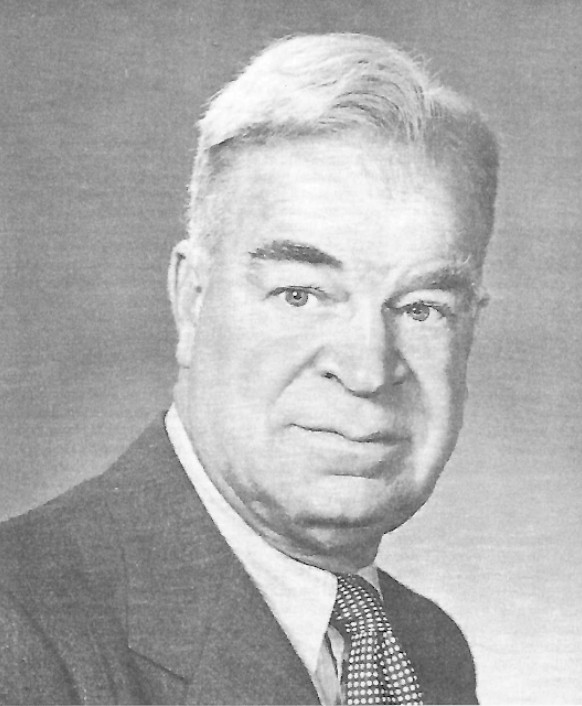
Over a half century after Luther B. Askin’s death several 2013 obituaries illustrated his continued influence on his former students. Gerald R. Reed’s family stated that “Jerry” transferred from General Martin Central School to Lowville Academy in order to play in Luther B. Askin’s band. He graduated from Lowville in 1940. He was a trumpet player in the Lowville Village band for several years. Raymond Gordon’s obituary, a 1934 graduate of Lowville Academy, also included mention of playing in the Lowville Academy band. By 1910, the US Census reported Luther Askin was a single boarder who resided in the household of Frank M. Kieb; twenty years later the US census confirmed his residence at the same address on Dayan St.
Askin registered for the World War I draft in June of 1917 where his description lists him as tall (6” 3 =”), stout, not bald, with blue eyes (poor sight), and light hair. His registration card lists him as Caucasian.
However, Louis Henry Gates Jr. editor of African American Lives (2004) includes his father, Luther Askin, as the earliest known instance of integration in baseball in 1865. His team, the Florence Eagle, of western Massachusetts, lost only six games in three years. His nickname “Old Bushel Basket” resulted from his ability to catch baseballs and hang onto them as if he used a basket for catching them.
The Lowville Band won second place May 2, 1931 in Plattsburg overcoming several obstacles. One was a misunderstanding as to the required pieces to be played. They lacked the selected music but the judges decided to score the band as if their prepared pieces were the selected pieces. They earned 251 points out of a possible 300 in class B. A second obstacle was their appearance, no band uniforms. The NEW YORK STATE SCHOOL MUSIC NEWS (April 1946) published Askin’s article titled “High School Bands in Lowville” which reveals more information about the experience. Askin was reluctant to attend the competition as the band had no uniforms and he feared that the band would make a poor showing.
However, the young director wished to keep on the right side of the principal so arrangements were made for the 160 mile trip to Plattsburg. He had read that the Saranac Lake band had won the competition the previous year and wished his band to listen to them play. The bands participating drew lots and Lowville was to perform after the Saranac Lake band. Since the bands were assigned to rooms before their competitions none of the bands heard any that played before them. Askin asked Willard R. Green, director of the Saranac band to change numbers so that his band could hear Green’s band play as this was their first year. Green agreed to the change. This competition was the first certificate won by the Lowville band.
Ten volunteers drove the students to the competition. The band consisted of a cornet section of Alison Burhans, David Owens, Henry Humphrey, Paul Green, George Coahn, Dick Griffith, Harold Fairchild, Buddie Richardson, Betty Richardson, Owen Salisbury, Harold Strife, Martha Griffith and Ed Smith. The clarinets were played by David Darling, Lawrence Pfaff, Glenn Tyner, Elwell Tyner, Guy Fairchild, Howard Ross and Richard Barnett. John Mungo was the piccolo player. Alto was played by Harvey Humphrey, Gerald Wetmore and Louis Reed. Saxophonists included Bernice Duflo, Maxine Ulrich, Albert Lewis, Phillip Klett, and Milton Boshart. The trombone section included George Davis, Bradford Sennet, Lloyd Thompson and Patterson Thomas. William Parker played bass. Earle Barnes Jr. played the baritone. Earl Knapp handled the bass drum and the snare drums were played by George Reed and George Rapave.
A big open-air concert on the four corners was planned to raise funds for band uniforms. A quarter was the suggested donation. The White Lodge tea room held an an ice cream social fund raiser. By March 8, 1932 fifty nifty uniforms were purchased. Another concert in the red and white caps raised $125 towards the uniform fund. The Journal & Republican commented that none of the school songs were played; perhaps the band should learn some. The paper reported that a total of $150 was required to complete payment on the uniforms. Donations could be sent to Miss Ina Glenn.
The 1932 members of the band traveled through a blizzard to reach the final session of the Assembly in Albany. This trip was made in school buses.
Those who accompanied the band included Luther B. Askin, director; Leon A. Davis, superintendent; Clyde Geerling, Miss Helen Jewett, Miss Frances Bowman, teachers and Mrs. D. E. Griffith and Mrs. H. W. Humphrey. Governor Franklin D. Roosevelt also heard the band play.
During the 1930s Lowville was one of two state bands selected for national competitions. The first was in Des Moines IA while the second was in Cleveland OH. Finally, in 1938 the band did participate in the national contest in Albany.
Lowville also participated in the 1939 World’s Fair in New York. Ten-year-old Helen Schantz was the youngest member of the 56 band members.
The band was selected to lead the huge parade Wednesday afternoon.
The band gave concerts Monday, Tuesday and Wednesday mornings.
Three selections were played, Builders of Youth by O’Neil, Rosamunde by Shubert and Greetings to Lowville by Ralph Herrick. Notes on the score card commend the band’s firm steady style, earnest effort to rise above the common place, and fine leadership.
In one interview Luther was asked what year did Lowville Academy have the best band?
He replied that at the beginning of each year he was discouraged with each band but then they come along very well and make such an improvement that he was well pleased with them.
It’s a discouraging situation when you build up a band during the year and just when the players become good, you lose all the best ones and have to start over the next year.
Aikin’s career lasted over 60 years until his death in 1966. Dr. Earl Barnes described him as one of the most influential teachers he had. He also credited him with starting the first Lowville Academy band in 1928. Dr. Barnes said Mr. Aikin could teach anyone to play any instrument, even if they were tone deaf, except the piano.
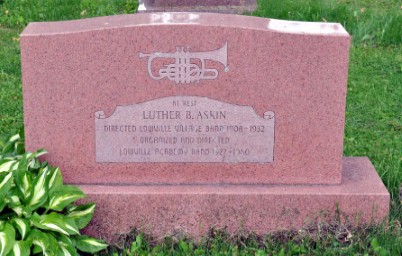
Lowville Rural Cemetery.